Saturday, 30 December 2017

Benaras style laggi tehai loved it urs.... enjoy n give views
Benaras style laggi tehai loved it urs.... enjoy n give views
watching video
watching video
Saturday, 23 December 2017
Repairing Tabla Problems
Repairing Tabla Problems
This is not a perfect world. For this reason, almost every tabla set created will have some problems to it. This chapter will deal will most common problems associated with owning a tabla set and how to fix them.
HEAD CHANGE
This is probably the most common problem in owning a tabla set. Some heads may die unnatural deaths due to water spilling on heads, syahi breaking off, depressed head to improper hammering, or inauspicious sound of the head split when attempting to tighten the head. Others may die naturally due to lack of elasticity, head being too old, excessive moisture, or lack of stability. Every tabla head will die one day or another.
First, disassemble the drum with the broken head completely. This means that you must find the end of the tasma and unweave it all out. Remember from Chapter 1 that tasma is made of raw leather hide. Imagine pulling raw leather hide with your bare hands. Wear workers gloves if you are intolerant too this kind of pulling and hand-work! When unweaving, be very careful not too pull too tightly or else the tasma will break.
Unweave it until the start of the tasma’s connection to the kundal. Do not disconnect the end tasma from the kundal, unless the tasma is in horrible shape.
Whether it’s your dayan or baya, you will finally see the inside of the shell. Here is a shot of my old tabla shells dissembled.
Now, you must accurately measure out the drum’s diameter from outer edge lips. Measurement accuracy is the key here. If you must round, round to the higher quarter inch. Tabla heads are very sophisticated and very size specific. There is very little tolerance in fitting the right size. If you were measuring a baya shell and measured out that it was 8.6 inches , go with the 8.75 inch head. It’s better to be safe with a bigger head than sorry with a smaller head.
Today, there are a lot of companies in the U.S.
What to look for in a good head? First, there should be all three layers of the head. Syahi should be layered and cracked while being tightly held. Inside the head, which no one really ever sees, make sure there is an inner layer beneath the kinnar known as the bharti. The bharti is the layer will protects the actual playing skin for excessive tension required. Bharti in most heads come in multiple units which are glued together. The first class head will have a single piece of bharti. If a head does not have bharti, do not even consider purchasing it. Make sure there is no dangling flesh or deformities in the head. Make sure that the head is circular! If the head is oval, then it will do no good to any drum, let alone tabla! I have seen oval headed dayans and tuning them was a nightmare. Make sure between two tasma holes in the gajra, there are three insertions. In total, there should be 48 insertions, in which sixteen equally spaced tasma holes are present. Lastly, make sure the syahi is circular with concentric circles, and no “gaps” or “craters.” Once these tests pass, make sure the head fits. If it does fit, then the reheading process takes place.
First, take small amounts of water and spread it around the bharti to make it moist. A little maidian with water won’t hurt the head. Under any circumstances, never put the water on the syahi’s side! Since the syahi is made of material that is water soluble, the drum will loose its tonal color and tuning such a ruined syahi is another nightmare!
Then mount the head on the shell of the drum. Take some rope and weave the head through the tasma holes around the kundal. This way, when tasma starts to come in, the head won’t sway around.
Begin weaving the tasma through. With tasma, reweaving can become cumbersome as well as annoying, as old tasma tend to go off in different direction. Frustration comes out when they realize that the tasma is in the incorrect orientation, remove the tasma end and reweave it again. The reweaving process can taken anywhere from an hour to two hours. Once the weaving process is done, it is time to tighten the drum. Start from the first tasma and tighten as much as possible. Tighten all the way until the end of the drum. Be sure to tie the knot at the end of the tasma’s length. After the tightening process, add gatta systematically. This means that when one gatta is added to one tasma, skip three over and add another gatta. This must be done equally. See if a resonant sound forms. If not, add a second gatta systematically. By this time, a resonant sound should form. If there is no resonant sound, retighten the head. In addition, remove the ropes used to keep the head in place from the start.
Now, it is time to tune the drum. Use the rules mentioned in Chapter 34, tune the tabla accordingly.
Also, give it time to relax. During a rehead-job, the heads will undergo tremendous change in pressure and tension. Therefore, after the rehead job is done, give it some time to get adjusted to the new surroundings. In addition, if the rehead is being done on the baya, then retighten it at least three times.
BROKEN TASMA / KUNDAL
This happens only with poor quality tabla sets. Find the broken tasma segment. Cut off some excess tasma from the end. Create a slit in the two ends of the broken tasma, so that the new excess tasma can fit in. Tighten the connection between the broken tasma and make sure it is strong. Of course, it is not as strong as one solid piece of tasma, but this will do during emergency situations. Add gatta if appropriate and retune the tabla. With manually repaired tasmas, it won’t tune as high pitched as it once could before. If possible, get a roll of new fresh tasma and rehead the tabla with it.
Broken kundals only happen in poor quality tabla sets. Only proper usage, no kundal should ever break. Should your kundal break, go to a hardware store and find a metal ring that will fit the bottom. It is actually the best alternative to the kundal, as metal rings won’t bend easily.
DENTED BAYAS
While carrying tabla sets, it is always possible that the baya will get dented. The only solution is to simply ignore it. A dented baya rarely affects the sound of the baya. Only dents that should take emergency action are if the baya looses its egg like shape all over. It is very possible that it could happen with a badly banged-around baya. If the dent is small and not too big, then ignore it. When the time comes for a rehead, one may take the tabla hammer covered with many cloths and hammer the dent out into its old shape.
BUZZING SYAHIS
Buzzing syahis result when the tabla set is placed in a room with high moisture. While playing certain bols, the buzz will get annoying. This is caused by two things: either high moisture or a loose particle of the syahi. If the cause is high moisture, then wait until the room is dryer and check if the drum buzzes or not. If it still buzzes, then there is a loose syahi particle. One must find the particle and gentle dab it on with a tiny piece of glue. Be very careful, because too much glue can make a mess with the intricate layering of the syahi.
These are some of the most common repair situations that tabla players will deal with and must know how to repair these events. Repairing tabla requires knowledge of the tabla as well rough hands. Of course, the first rehead on the tabla will not always be the best. Throughout time and practice, however, tricks and tactics will help one succeed in fixing tabla problems when they arise.
Theka, Prakar, and Laggi
Theka, Prakar, and Laggi
“Theka” and “prakar” are words that should be quite familiar to you. Let us revisit these terms again.
Theka is the simplest form of the tala using as few bols as possible to get the original flow of the tala. Usually, there is a 1:1 bol to matra ratio. The theka, besides the tala structure, is the way to determine which tala it is. If you see a Figure 21.1 anywhere, I’m sure you will point it what the correct answer it is.
X(0)
|
2
|
3
| ||||
1
|
2
|
3
|
4
|
5
|
6
|
7
|
tin
|
tin
|
nā
|
dhin
|
nā
|
dhin
|
nā
|
This is the theka of rupak tala. It is pretty obvious that we talked about thekas pretty much in Unit 2.
In Unit 2 and Chapter 17 of Unit 3, we talked about prakar. A prakar is an alteration of form of a tala. Here is a prakar used in Chapter 17 of rupak tala.
X(0)
|
2
|
3
| ||||||||||||||||||||||||||||||||||||||||||||||||
1
|
2
|
3
|
4
|
5
|
6
|
7
| ||||||||||||||||||||||||||||||||||||||||||||
tin
|
tin
|
nā
|
dhin
|
-
|
nā
|
nā
|
dhin
|
-
|
nā
|
nā
What do thekas and prakars both have in common? They are both cyclic forms. Remember from Chapter 20 that cyclic forms consume cycle of certain number of matras. Also remember the important distinction made in the previous chapter. Thekas and prakars are both examples of cyclic forms. However, any cyclic form is not necessarily a theka or prakar.
Having said that point, we must also not confuse “theka” with “prakar.” Theka is the simplest form given in a fixed number of matras. “Prakar” is a variation, and it is not always in the simplest form. As you can see, we will have many more cyclic forms to be discussed that would also need distinction and clarification.
If you remember from Chapter 8, there was special type of prakar for symmetrical talas. They were called ādhā prakārs, since they cut the tala in half using the appropriate changes in baya bols. You may see the adhaprakars used in Chapter 8 for bhajani tala or the adha prakar for tintal. Here is an example of an adha prakar for ektal.
| ||||||||||||||||||||||||||||||||||||||||
Advanced Lesson: Ustad Zakir Hussain's "DhatiDhagena Dha Tirakita,"
Advanced Lesson: Ustad Zakir Hussain's "DhatiDhagena Dha Tirakita,"
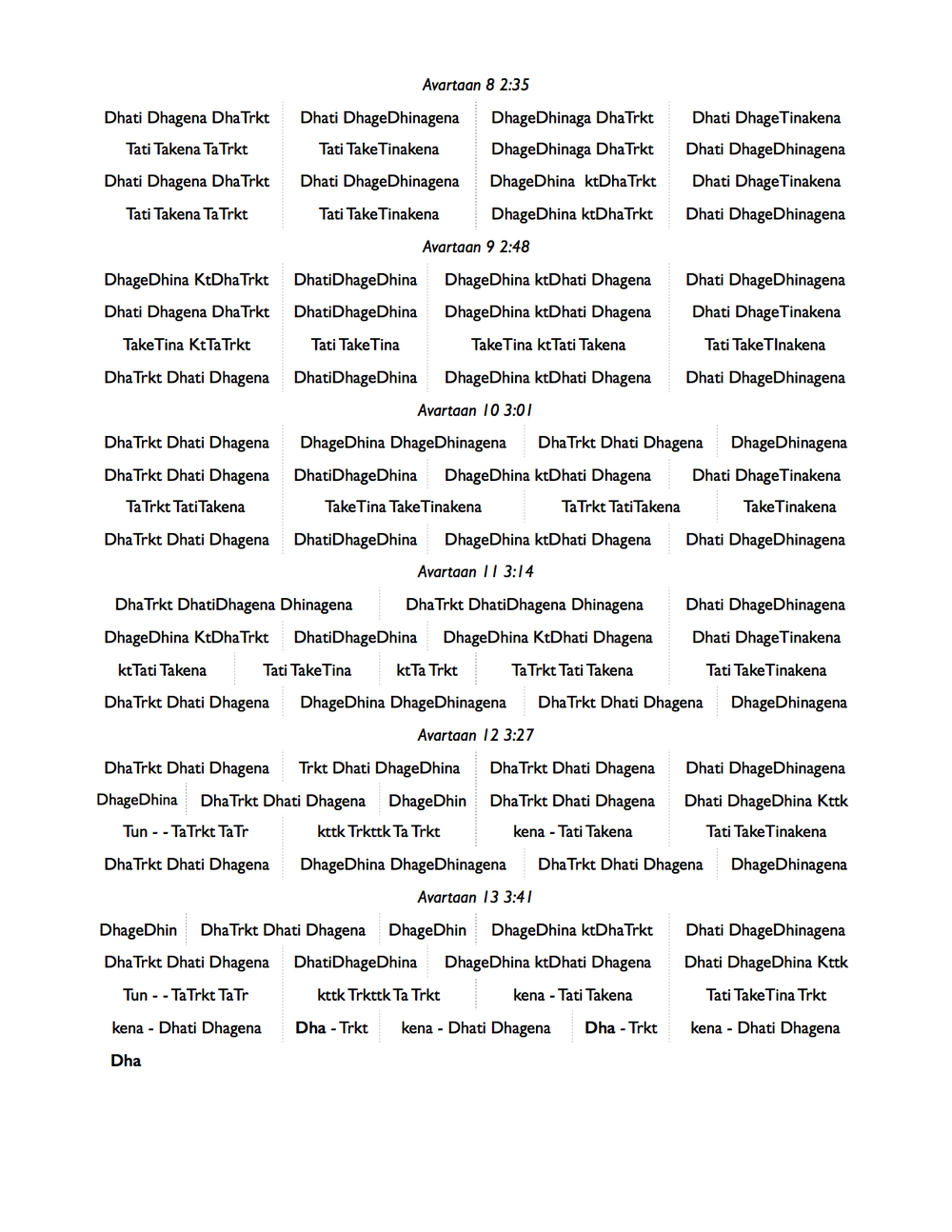
As the title of this lesson suggests, this is the complete full-speed development of DhatiDhagena DhaTirakita as performed by Ustad Zakir Hussain on the album Selects. I've long been captivated by this performance and finally decided to transcribe it to better understand Zakir ji's development process. The transcription notes the time when each cycle is played so you can follow along. If you don't own this album, buy it! It represents some of the finest examples of Tabla music ever released.
I'm going to post the transcription both as jpegs and as a pdf to download. Please note that the paltas are broken down into constituent blocks of phrases, not by matra. I feel that this makes the composition much easier to read and better illuminates the thought process.
After completing the transcription, a few things jumped out at me. Note that the bol tirakita, the primary subject of this kaida, is not played to an overwhelming degree; In fact, the only time two "Dha Tirakita" phrases are ever played back to back is once in avartaan 11 (in fact, the phrase is "Ta Tirakita" as it only occurs in the khali section). The relationship between "Dha Tirakita" and its neighboring phrases of "Dhati" and "Dhagena" are of much more interest to Zakir ji. The entire development is distinguished by the fluidity of the paltas, the use of farashbandi (paltas where the khali section does not match the bhari section, such as avartaans 4 and 11 among others), and the way one palta informs the next. Note that the extended roll in the khali section of avartaans 12 and 13 is a throwback to Ustad Habibuddin Khan. Overall the performance has a feeling of spontaneity which I find extremely enjoyable.
I hope that other tabla players can use this transcription to help inform their own kaida developments, rather than just memorize and imitate this one. In a future blog post I'll provide a transcription of my guru Pandit Sudhir Mainkar's development of this same kaida for contrast. If you appreciate this material and want to see more, let me know!

PESHKAAR ( पेशकार )
PESHKAAR ( पेशकार )
| ( पेशकार ) | |||||||
| धींक्ङ | धिंधा | ऽधा | धिंधा | धाति | धाति | धाधा | धिंधा |
| तित्धा | ऽगधाऽ | धिंधा | धाति | धाऽऽक्ङ | धाति | धाधा | धिंधा |
| तींक्ङ | तिंता | ऽता | तिंता | ताति | ताति | ताता | तिंता |
| तित्धा | ऽगधाऽ | धिंधा | धाति | धाऽऽक्ङ | धाति | धाधा | धिंधा |
| ( प्रकार - १ ) | |||||||
| धींक्ङ | धिंधा | ऽधा | धिंधा | धींक्ङ | धिंधा | ऽधा | धिंधा |
| धींक्ङ | धिंधा | ऽधा | धिंधा | धिंधिं | धाति | धाधा | धिंधा |
| तींक्ङ | तिंता | ऽता | तिंता | तींक्ङ | तिंता | ऽता | तिंता |
| धींक्ङ | धिंधा | ऽधा | धिंधा | धिंधिं | धाति | धाधा | धिंधा |
| ( प्रकार - २ ) | |||||||
| धींक्ङ | धिंधा | ऽधा | धिंधा | घेनाऽधा | तिधागेन | धातिधागे | धिनागिना |
| तींक्ड | तिंता | ऽता | तिंता | घेनाऽधा | तिधागेन | धातिधागे | धिनागिना |
| ( प्रकार - ३ ) | |||||||
| धींक्ङ | धिंधा | ऽऽताधा | धिंधा | ऽऽगिनधाति | धागेनधाऽऽ | ऽऽधागे | धिनागिना |
| तींक्ङ | तिंता | ऽऽताता | तिंता | ऽऽकिनताति | ताकेनताऽऽ | ऽऽधागे | धिनागिना |
| ( तिहाइ ) | |||||||
| धाऽऽक्ङ | धाति | धाधा | धिंधा | धाति | धाति | धाधा | धिंधा |
| ताऽऽक्ङ | ताति | ताता | तिंता | धाति | धाति | धाधा | धिंधा |
| तिटघला | ऽनधाऽ | धिंता | धाति | धा | ऽ | तिटघला | ऽनधाऽ |
| धिंता | धाति | धा | ऽ | तिटघला | ऽनधाऽ | धिंता | धाति |
| धा | |||||||
| ( प्रमुख पेशकार ) | |||||||
| धींक्ङ | धिंधा | ऽधा | धिंधा | धिंधिं | धाति | धाधा | धिंधा |
| तित्धा | ऽगधाऽ | धिंधा | धाति | धाऽऽक्ङ | धाति | धाधा | धिंधा |
| किटतक | तींऽऽक्ङ | तिंता | किटतक | तिनतिना | किनातागे | तिरकिटतिऽनऽ | तिनाकिना |
| तक्घङा | ऽनधाऽ | धिंता | धाऽऽक्ङ | धाधिं | ताधा | ऽक्ङधाऽ | धिंता |
| धा | |||||||
COMPOSITION Zakir Hussain, कायदा kaida
COMPOSITION L
Zakir Hussain plays the कायदा below often.
Zakir Hussain plays the कायदा below often.
| ( कायदा ) | |||||||
| धाऽ तिर | किटतक | तिरकिट | धाऽ तिर | किटतक | तिरकिट | धिना | गिना |
| धाति | धागे | धिना | गिना | धाति | धागे | धिना | गिना |
| ताऽ तिर | किटतक | तिरकिट | ताऽ तिर | किटतक | तिरकिट | धिना | गिना |
| धाति | धागे | धिना | गिना | धाति | धागे | धिना | गिना |
| ( पलटा - १ ) | |||||||
| धाऽ तिर | किटतक | तिरकिट | धाऽ तिर | किटतक | तिरकिट | धिना | गिना |
| धाऽ तिर | किटतक | तिरकिट | धाऽ तिर | किटतक | तिरकिट | धिना | गिना |
| धाऽ तिर | किटतक | तिरकिट | धाऽ तिर | किटतक | तिरकिट | धिना | गिना |
| धाति | धागे | धिना | गिना | धाति | धागे | धिना | गिना |
| ताऽ तिर | किटतक | तिरकिट | ताऽ तिर | किटतक | तिरकिट | तिना | किना |
| ताऽ तिर | किटतक | तिरकिट | ताऽ तिर | किटतक | तिरकिट | तिना | किना |
| धाऽ तिर | किटतक | तिरकिट | धाऽ तिर | किटतक | तिरकिट | धिना | गिना |
| धाति | धागे | धिना | गिना | धाति | धागे | धिना | गिना |
| ( पलटा - २ ) | |||||||
| धाऽ तिर | किटतक | धाऽ | धाऽ तिर | किटतक | तिरकिट | धिना | गिना |
| धाति | धागे | धिना | गिना | धाति | धागे | धिना | गिना |
| ताऽ तिर | किटतक | ताऽ | ताऽ तिर | किटतक | तिरकिट | धिना | गिना |
| धाति | धागे | धिना | गिना | धाति | धागे | धिना | गिना |
| ( पलटा - ३ ) | |||||||
| धाऽ तिर | किटतक | तिरकिट | तकतिर | किटतक | तिरकिट | धिना | गिना |
| धाति | धागे | धिना | गिना | धाति | धागे | धिना | गिना |
| ताऽ तिर | किटतक | तिरकिट | तकतिर | किटतक | तिरकिट | धिना | गिना |
| धाति | धागे | धिना | गिना | धाति | धागे | धिना | गिना |
| ( पलटा - ४ ) | |||||||
| धाऽ तिर | किटतक | तिरकिट | तकतिर | किटतक | तिरकिट | धिना | गिना |
| धाऽ तिर | किटतक | तिरकिट | तकतिर | किटतक | तिरकिट | धिना | गिना |
| धाऽ तिर | किटतक | तिरकिट | तकतिर | किटतक | तिरकिट | धिना | गिना |
| धाति | धागे | धिना | गिना | धाति | धागे | धिना | गिना |
| ताऽ तिर | किटतक | तिरकिट | तकतिर | किटतक | तिरकिट | तिना | किना |
| ताऽ तिर | किटतक | तिरकिट | तकतिर | किटतक | तिरकिट | तिना | किना |
| धाऽ तिर | किटतक | तिरकिट | तकतिर | किटतक | तिरकिट | धिना | गिना |
| धाति | धागे | धिना | गिना | धाति | धागे | धिना | गिना |
| ( पलटा - ५ ) | |||||||
| धाऽ तिर | किटतक | तिरकिट | धाऽ तिर | किटतक | तिरकिट | धिना | गिना |
| धा | ऽ | धिना | गिना | धाति | धागे | धिना | गिना |
| ताऽ तिर | किटतक | तिरकिट | ताऽ तिर | किटतक | तिरकिट | धिना | गिना |
| धा | ऽ | धिना | गिना | धाति | धागे | धिना | गिना |
| ( तिहाइ ) | |||||||
| धाऽ तिर | किटतक | तिरकिट | धाऽ तिर | किटतक | तिरकिट | धिना | गिना |
| धा | ऽ | धिना | गिना | धाऽ तिर | किटतक | तिरकिट | धाऽ तिर |
| किटतक | तिरकिट | धिना | गिना | धा | ऽ | धिना | गिना |
| धाऽ तिर | किटतक | तिरकिट | धाऽ तिर | किटतक | तिरकिट | धिना | गिना |
Subscribe to:
Comments (Atom)